



In the power tools industry, there is an expectation of performance and reliability every time a tool is used. From industrial-grade saws in manufacturing plants to handheld drills used on construction sites, power tools must stand up to heavy use job after job.
One thing that contributes to reliable performance is the quality of the parts and components that make up the tools themselves. After all, when the individual parts are manufactured with precision from high quality materials, they assemble securely, stay aligned, move within tolerances, and help keep the other parts and components working properly.
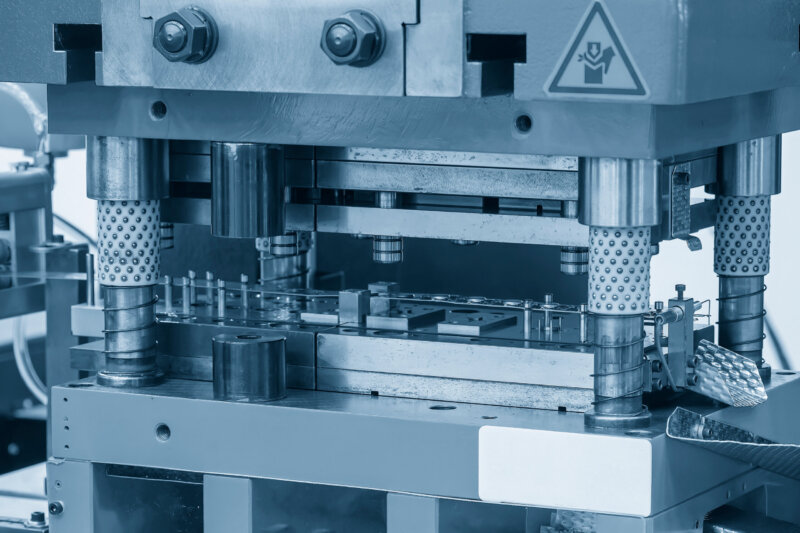
Progressive die stamping is an essential process for creating many important parts used in power tools, often small parts that secure, connect, or fasten others in place. These clips, brackets, pins, plates, and contacts are usually produced in large volumes and need to meet precise dimensions and tolerances. The most efficient way to produce them is often through progressive stamping.
Keep reading to learn more about the advantages of progressive stamping for power tool components.
How Progressive Die Stamping Benefits Power Tool Components
Progressive die stamping is a single-setup process that quickly fabricates large volumes of components with great precision. It is compatible with many types of metal, including steels, aluminum, copper and copper alloys, brass, and others. Proper material selection is also critical to achieving parts that are up to the vibrations, torque, and heavy use cycles most power tools experience.
The foundational concept behind progressive stamping is that the part is made by performing a series of steps in a specific order, creating part features progressively over and over along the strip, like a production line. Steps in the stamping process include:
- Single setup. The press is fitted with a long die that includes multiple “stops” or stations, each performing a different operation in the sequence, like blanking, bending, shearing, or coining.
- Continuous automated workflow. Strips of metal are fed from a large coil into the stamping press and advance through it automatically at measured intervals. This keeps the metal aligned with the die so all operations are performed in the correct location on the strip.
- Incremental transformation. With each stroke of the press a new part feature is added, then the strip advances and the next operation is performed. The stations are spaced so that multiple parts are formed along the strip at once, resulting in a high volume of parts with minimal variation. The last station on the die creates the final part feature, then the finished piece is knocked from the metal strip as the material exits the press.
- Uniformity. This workflow minimizes material handling and human error, resulting in high-quality components with tight tolerances and uniform features.
Overcoming Challenges in High-Volume Manufacturing
Power tools contain many small parts that are vital for making electrical connections, holding blades or bits in place, anchoring internal components, or shielding internal circuitry. Often these parts have intricate cuts and shapes and need to fit in small spaces with little room for dimensional errors. For example, a bracket may have multiple bends at specific angles, or a switch contact needs to fit snugly inside a small compartment.
Parts like this can be challenging to fabricate consistently with processes like machining or manual cutting, bending, and forming. Not only does it take time to perform each operation, but every time workpieces are transferred from one machine to another, the risk of misalignment and error increases.
Stamping is the ideal method because the punches and dies used to create part features strike the material identically each time, resulting in minimal variation between parts and between batches. And for small and complex parts with multiple features, progressive stamping is a top choice for high-volume production.
Precision metal stamping consolidates multiple operations into one comprehensive tool that fits into a single high-speed press. This integrated approach streamlines the production process, dramatically improving operational efficiency. Due to its automation capabilities, custom metal stamping enables quick, high-volume output without compromising quality.
Precision metal forming services significantly reduce the risk of tooling errors and can reduce or eliminate the need for expensive secondary operations like deburring or grinding. The result is a reliable solution for precision parts that fit properly in power tool assemblies.
Partner With an Expert in Progressive Die Stamping
Manufacturers rely on progressive die stamping to produce durable, high-performance parts for the power tools industry. From design to material selection to prototyping to high-volume production, American Industrial Company partners with customers to create components that meet their requirements and perform reliably.
Contact us today to learn more about the benefits of progressive die stamping and see how American Industrial Company can help bring your next project to life.